
You’ve decided you want a deck. The vision is there — summer evenings outside, a space for friends and family, finally making use of that backyard. Now comes the first real decision: what do you build it out of? For most Minnesota homeowners, that comes down to two options — a traditional cedar deck vs. composite. Both are great choices. They just suit different homeowners, and knowing the difference upfront saves you a lot of second-guessing once the project is underway.
Here’s a straightforward breakdown of both so you can walk into your estimate already knowing what you want.
Table of Contents:
- What Is a Cedar Deck?
- What Is a Composite Deck?
- The Big Differences Between Cedar Decks and Composite
- So Which One Is Right for You?
What Is a Cedar Deck?
Cedar is natural wood — real lumber, locally sourced, built the traditional way. It has a warmth and character that’s hard to replicate. The grain, the texture, the smell of fresh-cut wood — there’s a reason people have been building cedar decks for decades. It’s a classic for a reason.
Decked Out MN sources its cedar lumber locally and uses only premium quality boards, so you’re not getting the bargain bin stuff. A well-built cedar deck, properly maintained, holds up beautifully and can last just as long as composite — and honestly, look just as good.
The catch is that “properly maintained” part. We’ll get to that.
What Is a Composite Deck?
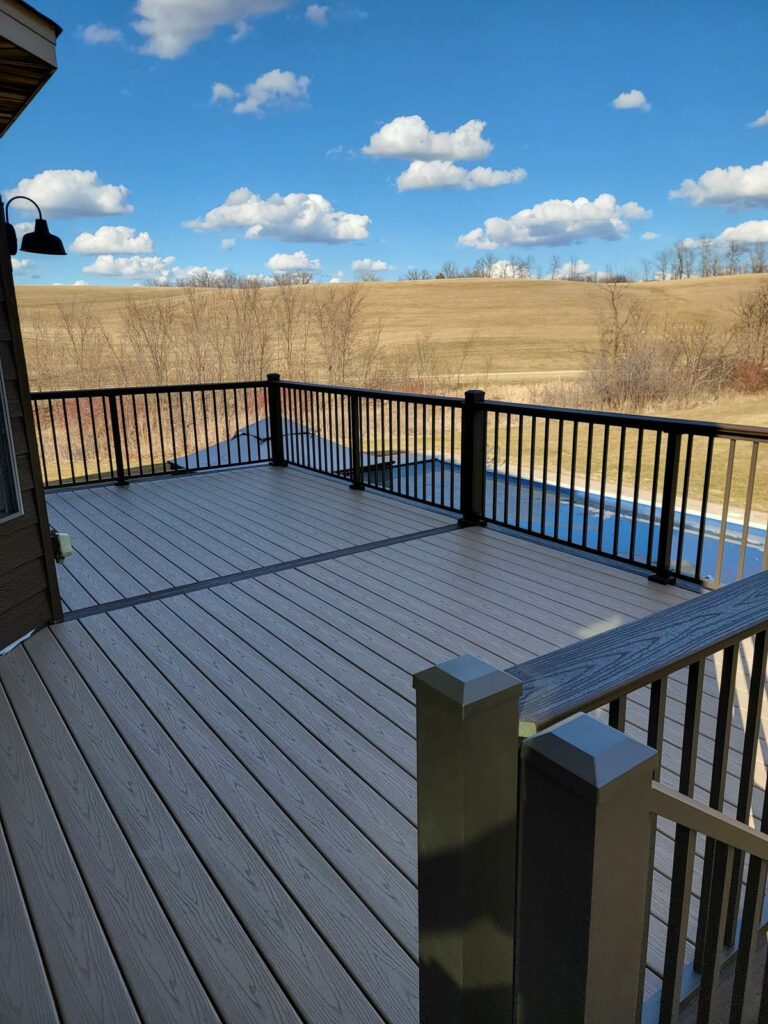
Composite decking — brands like Trex, Azek, TimberTech, and Zuri — is made from a mixture of wood fibers and composite plastics. It’s engineered to look like wood without the upkeep that comes with real wood. The technology has come a long way in recent years, and modern composite decks are genuinely beautiful — rich colors, realistic texture, and a finished look that holds up year after year.
The tagline for our low maintenance decks is “No Paint, No Stain, No Pain” — and that pretty much sums it up.
The Big Differences Between Cedar Decks and Composite
Maintenance
This is the biggest factor for most homeowners, so let’s be direct about it.
A cedar deck needs annual maintenance. That means cleaning, sanding, and re-staining or resealing every year or two to protect the wood from moisture, UV rays, and Minnesota’s freeze-thaw cycles. Skip it for a season or two and you’ll start to see the wood gray out, crack, or warp. It’s not a dealbreaker — plenty of homeowners enjoy the ritual and keep their cedar decks looking sharp for decades — but it is a real time commitment.
A composite deck needs essentially none of that. Occasional soap and water cleaning is about as demanding as it gets. No staining, no sealing, no annual projects. You build it and then you just use it.
Durability in Minnesota’s Climate
Minnesota winters are not gentle. Freeze-thaw cycles, heavy snow loads, and brutal temperature swings test any outdoor material hard.
Composite decking is specifically engineered to handle this. Brands like Trex and Azek are built to resist moisture, fading, staining, and the expansion and contraction that comes with extreme temperature changes. They don’t splinter, they don’t rot, and they don’t gray out from UV exposure.
Cedar handles Minnesota winters well too — but only when it’s properly maintained. An unmaintained cedar deck in this climate will show its age faster than the same deck would in a milder state.
Upfront Cost
Cedar is generally more affordable upfront. If budget is the primary constraint, a cedar deck gives you a beautiful, high-quality outdoor space at a lower initial price point.
Composite costs more to install. The materials themselves are pricier, and that’s reflected in the estimate. That said, when you factor in the cost of maintenance products and labor over the life of a cedar deck, the gap between the two often closes over time.
Lifespan
Both can last a long time when done right. A well-maintained cedar deck built with premium lumber can last 25–30 years. Composite decks are similarly durable and often come with manufacturer warranties — some covering 25 years or more — with significantly less effort required to get there.
Appearance
Cedar has a natural warmth that composite has worked hard to match — and modern composite products have genuinely gotten close. Brands like Zuri and Trex Transcend offer deep, realistic wood grain textures and color options that look far more sophisticated than the composite decking of ten years ago.
That said, if the look and feel of real wood is something you feel strongly about, cedar still has an edge. There’s a tactile authenticity to it that’s hard to manufacture.
So Which One Is Right for You?
Here’s an honest way to think about it. Cedar is a great fit if you appreciate the look and feel of real natural wood, while Composite is the better fit if you want a beautiful deck with minimal ongoing effort.
| Comparison | Cedar | Composite |
| Upfront Cost | More affordable | Higher upfront investment |
| Maintenance | Annual staining/sealing required | Soap and water — that’s it |
| Lifespan | 25–30 years with proper care | 25+ years with minimal effort |
| Minnesota Winters | Holds up well when maintained | Engineered specifically for it |
| Appearance | Natural wood warmth and texture | Realistic wood look, wide color options |
| Manufacturer Warranty | None | Yes — varies by brand |
| Best For | Homeowners who love real wood and don’t mind upkeep | Homeowners who want beauty without the annual maintenance |
Neither choice is wrong. It really comes down to your lifestyle, your budget, and how much time you want to spend maintaining your outdoor space over the years.
Need a Second Opinion?
Now that you know the difference, the best next step is talking to someone who can look at your space, understand what you’re going for, and help you make a decision that fits your home and your life.
Decked Out MN builds both — premium cedar decks with locally sourced lumber and low maintenance composite decks using top brands like Trex, Azek, TimberTech, and Zuri. Either way, you’re getting exceptional craftsmanship and a deck built for Minnesota.
When you’re getting real about your deck…
Get your FREE deck estimate here and take the first step toward the backyard you’ve been picturing.